
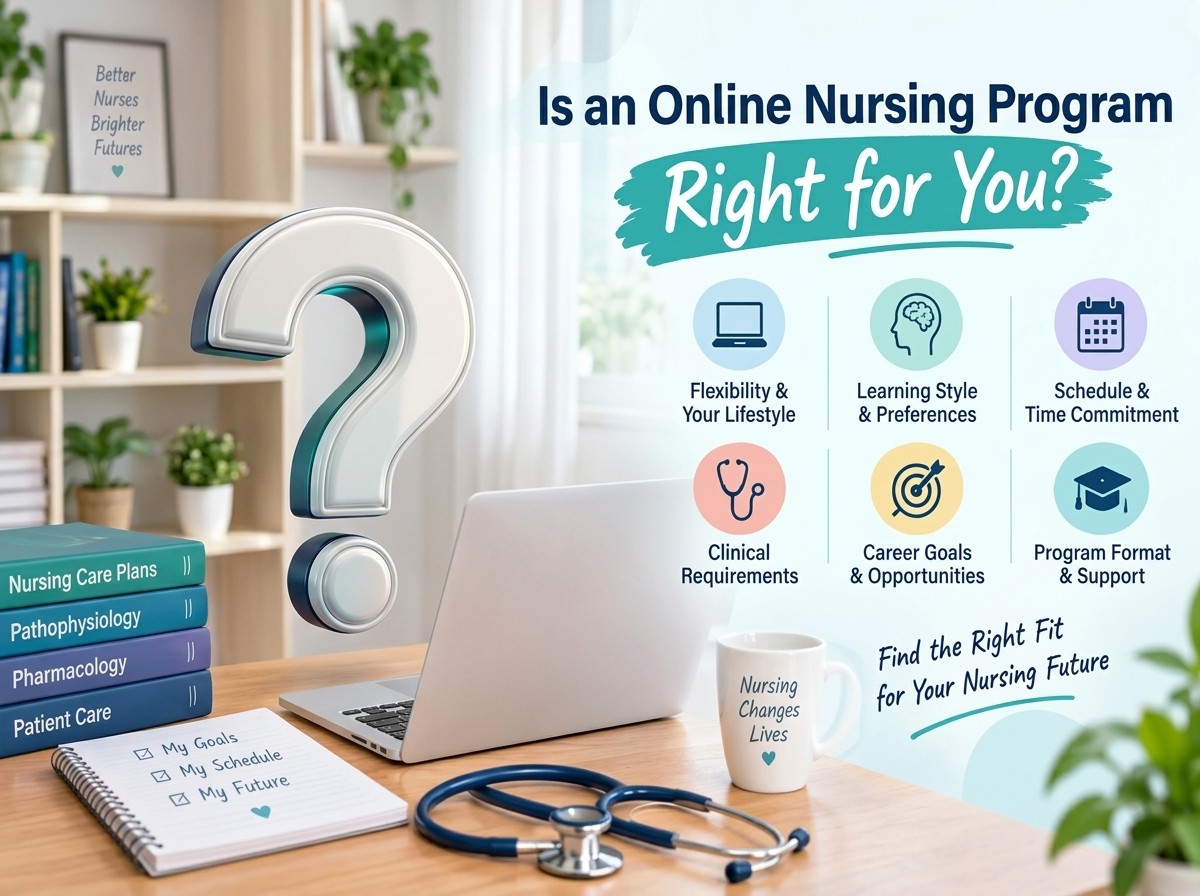
Online Nursing Programs: Costs, Degrees & How to Choose
A few years ago, the phrase “nursing school” conjured images of bleary-eyed students hunched over textbooks in a campus library at 3 a.m. Today, that image looks dramatically different. The nurse sitting next to you on the unit may be quietly completing a master’s-level discussion post during a break, or a new graduate may be logging into an anatomy lecture from a kitchen table in a completely different state. Online nursing programs have shifted from being a niche option for the already-licensed to a legitimate, rigorous pathway into the profession. But with that convenience comes a landscape that is harder to navigate. Tuition ranges from roughly $14,000 to well over $80,000 depending on the degree and institution. Admission requirements vary so widely that two programs with the same name can feel like entirely different animals. And the question that trips up more prospective students than any other—”Is this program actually accredited?”—often gets buried beneath marketing promises.
This guide is built to cut through that noise. Whether you are an ADN-prepared nurse considering an RN-to-BSN bridge or a career-changer weighing a direct-entry MSN, the goal here is to give you a clear-eyed, financially grounded framework for choosing an online nursing program that genuinely fits your life and your career.

Explore flexible online nursing programs, compare degree options, understand costs and requirements, and choose a pathway that fits your nursing career goals.
Nursing education, licensure, clinical requirements, and program approval can differ by state.
What Are Online Nursing Programs?
Online nursing programs deliver some or most academic coursework through a digital learning platform. Depending on the degree, students may watch lectures, participate in discussions, complete assignments, take exams, and meet instructors virtually. However, “online” does not necessarily mean 100% remote.
Programs that prepare students for initial nursing licensure typically involve hands-on learning, simulation, clinical experiences, or other in-person requirements. Nursing-accreditation organizations also expect distance-delivered programs to provide opportunities for students to develop and demonstrate clinical competence.
That makes the delivery model one of the first things to investigate.
Common online formats
| Format | What it usually means |
|---|---|
| Fully online | Most academic work is completed remotely. |
| Hybrid/blended | Online coursework combined with in-person learning |
| Synchronous | Classes or activities occur at scheduled times. |
| Asynchronous | Students complete materials on a flexible schedule. |
| Online with local clinicals | Academic work is online, while clinical education is completed at an approved location |
Types of Online Nursing Programs
There isn’t one “online nursing degree.” Nursing education includes multiple pathways, from entry-level study to doctoral education. AACN lists baccalaureate, master’s, DNP, PhD, accelerated, and other nursing education pathways.
1. Online LPN/LVN Programs
LPN/LVN education is an entry-level nursing pathway in the United States. Programs generally combine classroom education with supervised practical experience.
Because practical nursing is hands-on, prospective students should be cautious about programs advertising a pre-licensure pathway as completely remote.
2. Online ADN Programs
An associate degree in nursing can prepare students for RN licensure and is one of the education routes identified by the U.S. Bureau of Labor Statistics. BLS notes that aspiring RNs commonly enter the profession through a bachelor’s degree, associate degree, or diploma pathway from an approved program.
For an ADN program, ask specifically where skills labs and clinical rotations take place.
3. Online BSN Programs
A Bachelor of Science in Nursing can serve as an entry-to-practice pathway or a degree-completion option, depending on the student’s previous education and nursing status.
AACN describes the BSN as developing capabilities such as critical thinking, leadership, case management, and health promotion.
4. Online RN-to-BSN Programs
For already licensed RNs, an RN-to-BSN program can be one of the most practical online options because much of the curriculum can be delivered remotely.
These programs are designed to build on previous nursing education rather than repeat entry-level clinical preparation.
5. Online MSN Programs
A Master of Science in Nursing can support advanced education in areas such as nursing leadership, education, administration, and advanced practice, depending on the program.
The admission route varies. Some MSN programs expect applicants to already hold a BSN, while others are designed for different educational backgrounds.
6. Online DNP Programs
The Doctor of Nursing Practice is a practice-focused doctoral pathway. Online or hybrid DNP programs are available, although students should examine clinical, practicum, residency, and project requirements carefully.
AACN includes the DNP among its recognized nursing education pathways, and current accreditation resources show nursing programs being offered through distance formats.
How Much Do Online Nursing Programs Cost?
One of the biggest mistakes applicants make is comparing tuition alone.
The real cost can include:
- Tuition
- Mandatory program fees
- Books and digital materials
- Technology and software
- Exam or testing fees
- Clinical or lab expenses
- Travel and accommodation for in-person requirements
- Licensure and application costs
The U.S. Department of Education recommends looking beyond the advertised “sticker price” and comparing net price—what you are actually expected to pay after grants and scholarships.
A simple way to think about it is:
Total education cost − grants/scholarships = estimated net cost
Don’t assume an online program is automatically cheaper than a campus-based program. An inexpensive tuition rate can become less attractive when required fees, travel, clinical expenses, or additional coursework are added.
For school-by-school comparisons, federal tools such as College Scorecard can help students examine costs and outcomes.
The Real Cost of Online Nursing Programs
One of the most persistent myths about online education is that it is automatically cheaper than on-campus study. The truth is more nuanced. Online programs eliminate commuting and often reduce campus fees, but tuition per credit hour can still be substantial.
The variance across degree levels is striking. At the RN-to-BSN level, programs like Benedictine University’s online RN-to-BSN sit at $415 per credit hour, with a total estimated tuition around $14,110 for 34 credit hours. The University of San Diego’s RN-to-BSN program runs $600 per unit across 43–52 units, translating to a total tuition range of $25,800–$31,200. Chamberlain University’s RN-to-BSN tuition is $635 per credit hour, plus a $200 student services charge per session. For nurses already working, some employers offer tuition reimbursement that can absorb much of this cost—but never assume that benefit before confirming the details with HR.
At the MSN level, the range widens further. Simmons University’s online MSN in Nursing Leadership costs $1,288 per credit for 34 credits, totaling $43,792. Johns Hopkins’ online MSN Nurse Practitioner pathways are priced at $2,450 per credit. Rowan University offers its online MSN programs at $899 per credit, a significantly lower entry point for the same degree category. At the doctoral level, William Paterson’s Post-Master’s DNP comes in at $35,112 total, while Weber State’s DNP Executive Leadership program estimates a total of $17,500–$20,000.
The lesson here is not to chase the lowest number. A $40,000 MSN from a program with strong clinical partnerships and employer recognition may deliver a better return than a $20,000 MSN that employers in your region have never heard of. Cost matters, but it should be weighed alongside accreditation, clinical placement support, and regional reputation.
One often-overlooked factor: financial aid rules are shifting. Starting July 1, 2026, Grad PLUS Loans will no longer be offered for new borrowers, and borrowing limits will be introduced for new loans, meaning federal loans may no longer cover the full cost of attendance for many graduate students. If you are planning to start a graduate nursing program in fall 2026 or later, this is not a detail to file away for later. It directly affects how you finance the degree.
What Are the Requirements for Online Nursing Programs?
Requirements vary by degree and institution, but common admissions materials can include:
- High school diploma or equivalent
- Prerequisite science courses
- Minimum GPA
- Previous college coursework
- RN license for post-licensure programs
- Letters of recommendation
- Personal statement
- Background check or health documentation
- Immunization or clinical clearance requirements
Graduate programs may require professional nursing experience, a previous nursing degree, or specific prerequisite courses.
For a pre-licensure program, don’t stop at the school’s admission requirements. You should also check whether graduates are eligible for the licensing process in the state where you plan to practice.
The NCLEX organization states that each nursing regulatory body has its own eligibility requirements, so applicants should confirm requirements directly with the relevant regulator.
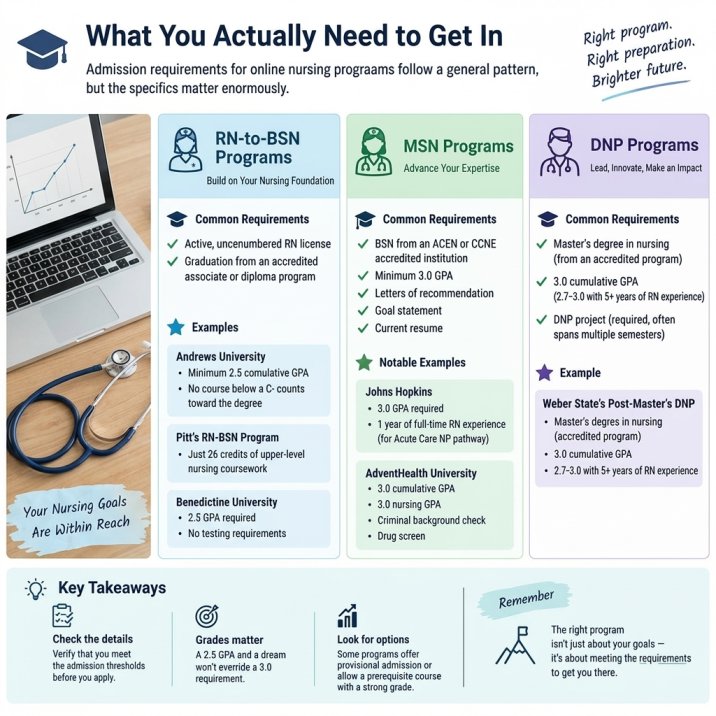
What You Actually Need to Get In: Online Nursing Program Requirements
Admission requirements for online nursing programs follow a general pattern, but the specifics matter enormously.
For RN-to-BSN programs, the baseline is straightforward: an active, unencumbered RN license and graduation from an accredited associate or diploma program. Andrews University requires a minimum cumulative GPA of 2.5 to graduate, with no course below a C- counting toward the degree. Pitt’s RN-BSN program requires just 26 credits of upper-level nursing coursework, making it one of the leaner completion pathways. Benedictine University requires a 2.5 GPA and no testing requirements for admission, which lowers the barrier for nurses who have been out of school for years.
MSN programs raise the stakes. Johns Hopkins requires a BSN from an ACEN or CCNE accredited institution, a minimum 3.0 GPA, and—for its Acute Care NP pathway—one year of full-time RN experience in a critical care or acute care setting. AdventHealth University’s MSN-MHA dual degree requires a 3.0 cumulative GPA and a 3.0 nursing GPA, plus a criminal background check and drug screen. Letters of recommendation, a goal statement, and a current resume are standard across most graduate programs.
DNP programs typically build on an MSN. Weber State’s Post-Master’s DNP requires a master’s degree in nursing from an accredited program and a cumulative GPA of 3.0, with a slightly lower threshold (2.7–3.0) for applicants with five or more years of full-time RN experience. A DNP project is a universal requirement across doctoral programs, often spanning multiple semesters.
The practical takeaway: before you fall in love with a program’s curriculum, verify that you meet the admission thresholds. A 2.8 GPA and a dream will not override a 3.0 requirement. If you are close but not quite there, some programs offer provisional admission or allow you to complete a prerequisite course with a strong grade to demonstrate readiness.
Why Accreditation Matters
Accreditation is one of the strongest checkpoints when evaluating a nursing program.
The Accreditation Commission for Education in Nursing (ACEN) accredits nursing programs at multiple levels, including practical, associate, baccalaureate, master’s, and clinical doctorate programs. ACEN explains that its accreditation can encompass different delivery methods, including online and distance education.
You can use ACEN’s program search to verify whether a nursing program is currently accredited. Search for ACEN-accredited nursing programs.
For baccalaureate and graduate nursing programs, another important accreditor is the Commission on Collegiate Nursing Education (CCNE). CCNE approved revised accreditation standards in July 2026, with the new standards taking effect for applicable evaluations from January 1, 2027. Don’t confuse institutional accreditation with nursing program accreditation.
A university can be institutionally accredited while its nursing program has a separate specialized accreditation status.
Before enrolling, verify the specific nursing program, not only the university’s name.
Choosing a Degree Pathway That Matches Your Career Stage
The alphabet soup of nursing credentials—ADN, BSN, MSN, DNP, post-master’s certificate—can feel overwhelming. But each degree serves a distinct purpose, and choosing the wrong one for your stage can cost you time and money.
The ADN remains the fastest route to RN licensure, but many hospitals are phasing out ADN-only hiring or requiring a BSN within a set timeframe. RN-to-BSN programs are designed for this exact situation: they accept your associate degree as a whole package and require a relatively small number of upper-level credits to bridge the gap. Andrews University, for example, recognizes the associate degree as a complete package and requires a minimum of 32 additional credit hours.
For nurses ready to specialize or move into advanced practice, the MSN is the gateway. Programs range from nurse practitioner tracks—which require significant clinical hours and often onsite immersions—to leadership and education tracks that can be completed almost entirely online. Johns Hopkins’ NP programs are delivered online with onsite immersions and clinicals in the Baltimore-Washington, DC region, a reminder that “online” in nursing rarely means “no clinical component.”
The DNP is the terminal practice degree, aimed at nurses who want to lead systems, influence policy, or teach at the doctoral level. It is not a clinical upgrade in the way an MSN is; it is a leadership and scholarship credential. William Paterson’s Post-Master’s DNP, for instance, prepares graduates for roles as chief nursing officers, directors of nursing, and quality and patient safety officers.
A post-master’s certificate can be a smart, targeted option if you already hold an MSN but want to add a new specialty—say, moving from nursing education into a nurse practitioner role—without completing a full second master’s degree.
How to Choose the Right Online Nursing Program
The single most important factor in choosing an online nursing program is accreditation. Not institutional accreditation—that is the baseline. You need programmatic accreditation from either the Commission on Collegiate Nursing Education (CCNE) or the Accreditation Commission for Education in Nursing (ACEN). These bodies review the specific nursing curriculum, faculty credentials, clinical resources, and student outcomes against established standards.
Why does this matter so much? Because accreditation determines whether your degree will be recognized by employers, whether you qualify for licensure in your state, and whether you can be admitted into graduate programs later. Stevenson University puts it plainly: accreditation ensures your degree is recognized by employers, qualifies you for licensure requirements, and meets the standards for admission into graduate nursing programs. If a program lacks CCNE or ACEN accreditation, treat that as a red flag regardless of how attractive the tuition or schedule appears.
Beyond accreditation, evaluate the following factors in order of importance:
1. Clinical placement support
This is where online programs separate themselves. Some programs, like the University of San Diego’s RN-to-BSN, provide concierge clinical placements, arranging preceptors and sites in your local area with the cost included in tuition. Others leave placement entirely to the student, which can be a logistical nightmare in competitive regions.
2. Format flexibility
Asynchronous coursework lets you study on your own schedule; synchronous sessions offer more structure and interaction. Consider which format actually fits your shift schedule and family obligations. An 8-week accelerated course may sound efficient until you realize it compresses the same workload into half the time.
3. Credit transfer policy
If you already hold an associate degree or prior college credits, a generous transfer policy can shave months and thousands of dollars off your program. Andrews University accepts up to 92 transfer credits from an associate degree.
4. Employer recognition in your region
A program with a national reputation may not carry weight with the specific hospital system you want to work for. Ask nurse managers and HR departments in your area which online programs they respect and which ones they have seen produce unprepared graduates.
5. Faculty accessibility
In an online environment, the quality of faculty engagement matters even more than in a classroom. Look for programs that advertise virtual office hours, proactive check-ins, and individualized feedback—not just a discussion board monitored by adjuncts.
6. Confirm your career goal.
Are you trying to become an RN, move from RN to BSN, enter graduate study, become an advanced-practice nurse, or move into leadership or education? Your goal determines the appropriate degree.
7. Check licensure eligibility
Ask whether graduates are eligible for the licensing process in the state where you intend to practice. State requirements can differ, and NCLEX eligibility is determined through the applicable nursing regulatory body.
8. Verify nursing accreditation
Check the program directly through recognized nursing-accreditation resources rather than relying entirely on marketing claims. ACEN provides a searchable directory of accredited programs.
9. Calculate the real cost
Don’t compare only the per-credit tuition.
Create a simple spreadsheet with:
| Cost category | Program A | Program B |
|---|---|---|
| Tuition | $ | $ |
| Mandatory fees | $ | $ |
| Books/materials | $ | $ |
| Clinical expenses | $ | $ |
| Travel | $ | $ |
| Estimated financial aid | $ | $ |
| Estimated net cost | $ | $ |
This approach gives you a much more realistic comparison than the headline tuition price.
10. Investigate clinical placement
Ask exactly how clinical placements work, who arranges them, and whether sites are available where you live.
11. Examine student support
Online students still need access to:
- Faculty support
- Academic advising
- Tutoring
- Technical support
- Library resources
- Career services
Distance education quality depends not only on the technology but also on how effectively the program supports learning. Nursing-accreditation standards explicitly address faculty, instructional design, and student support in distance education.
12. Look beyond marketing language
A polished website can tell you what a school offers. It doesn’t automatically tell you how well the program fits your licensing, financial, or career needs.
Look for concrete information about accreditation, outcomes, clinical requirements, curriculum, fees, and eligibility.
Online vs. Traditional Nursing Programs
| Factor | Online/Hybrid | Traditional Campus |
|---|---|---|
| Schedule flexibility | Often higher | Often more structured |
| Commute | Usually lower | Usually higher |
| Clinical learning | Often still required | Usually integrated on-site |
| Self-discipline | Very important | Important |
| Technology dependence | High | Moderate |
| Face-to-face interaction | Varies | Usually higher |
| Best for | Flexible learners and many working students | Students who prefer structured in-person learning |
Neither format is automatically right for every student. A strong program is one that provides appropriate academic and clinical preparation for the credential you are pursuing.
Do Online Nursing Programs Have Clinicals?
This is one of the most important questions to ask before applying.
For nursing, clinical education is not just another class. It is where students apply assessment, communication, patient safety, decision-making, and other competencies in real or simulated care environments.
A recent 2026 integrative review of 43 studies found that clinical skills were more difficult to acquire through distance education alone and that well-designed blended learning produced particularly positive outcomes.
So when a school says a program is “online,” ask:
Where will I complete my clinical hours?
Then ask:
Does the school arrange the placement, or must I find one myself?
Also ask whether clinical sites are available in your state or local area.
A Simple Checklist Before You Apply
Before submitting an application, confirm these seven questions:
☐ Is the nursing program properly accredited?
☐ Does it meet the requirements for the state where I plan to practice?
☐ What degree or credential will I receive?
☐ How much will I actually pay after financial aid?
☐ Where will clinicals or in-person requirements occur?
☐ How flexible is the schedule?
☐ What academic and technical support is available?
If you cannot get a clear answer to one of these questions, pause before paying an application or enrollment fee.
Final Thoughts: Is an Online Nursing Program Right for You?
Online nursing programs can make nursing education more accessible and flexible, especially for working nurses and students who need greater control over their schedules. But the strongest choice is not necessarily the program with the most attractive tuition or the word “online” in its advertisement.
Look at the whole picture: accreditation, licensing eligibility, clinical requirements, total cost, student support, and your own learning style.
Nursing is ultimately a hands-on profession, and the best online learning experience should support—not replace—the clinical knowledge and practical competence required for safe patient care. Current research and nursing-accreditation standards both reinforce the importance of combining effective digital learning with appropriate practical experiences.
The U.S. Bureau of Labor Statistics reports that registered nurses had a median annual wage of $97,550 in May 2025 and projects 6% employment growth from 2025 to 2035, although individual earnings and opportunities vary by location, setting, experience, and specialty.

Ready to compare programs?
Before you apply, make your own shortlist and compare each program’s accreditation, total cost, clinical structure, admission requirements, and state eligibility side by side. Then verify the final details directly with the school and the relevant nursing regulatory body.
Explore more NurseExe nursing education resources and share this guide with a nursing student or nurse planning the next step in their career.